
Helmholtz platform for the design of robust energy systems and their supply chains (RESUR)
RESUR Phase I (2022–2025)
Context and Objective
RESUR Phase I established a cross-sectoral analysis and advisory platform in response to the geopolitical disruptions following Russia’s war of aggression against Ukraine. This “Zeitenwende” exposed Germany’s dependence on fossil fuel imports and highlighted the need to strengthen energy security while maintaining the path to climate neutrality. As one of the four Helmholtz Energy’s “Zeitenwende Energy Security” initiatives—developed with partners from policy and industry—RESUR contributed to accelerating research, knowledge transfer, and energy system resilience.
Approach and Methodology
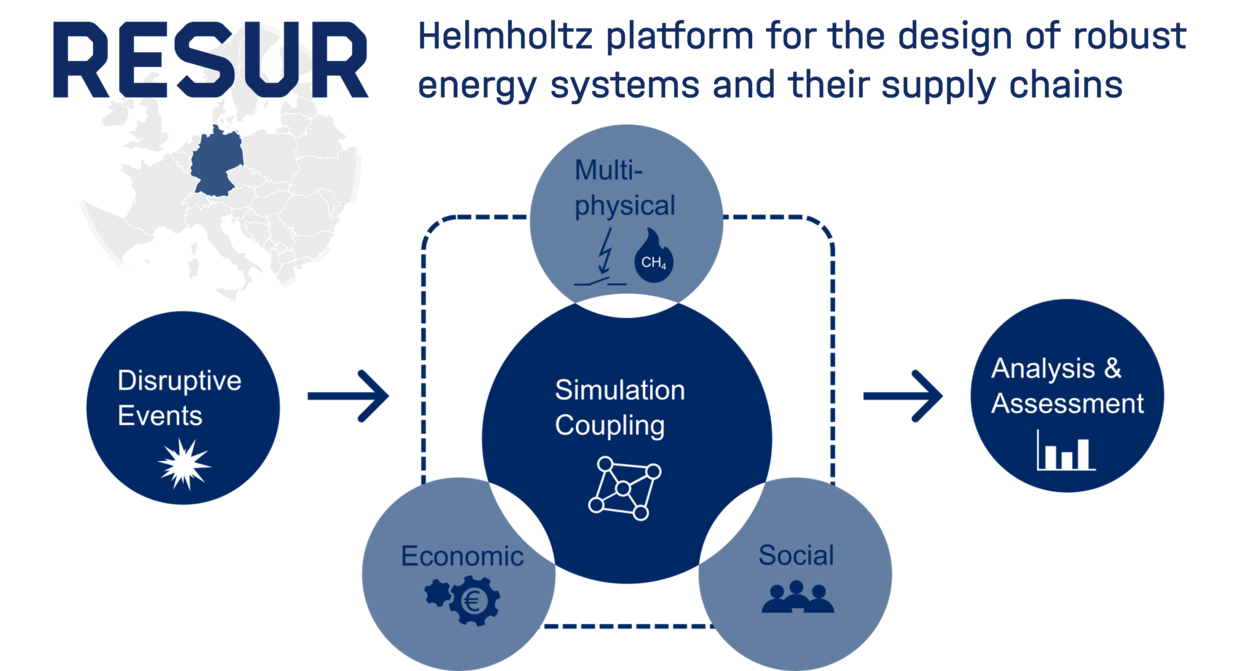
The platform provided rapid, scientifically grounded insights for crisis situations. It developed advanced co-simulation tools to capture interactions across energy domains and pioneered “re-bundling” in simulation, reconnecting electricity generation, transmission, distribution, and consumption across voltage levels. Integrated modeling of electricity, gas, and heat sectors enabled a holistic view of system interdependencies.
Key Results
RESUR I delivered short-term, event-driven decision support for supply crises and market disruptions while maintaining close exchange with stakeholders. A key outcome was a unique cross-domain modeling framework capable of capturing system complexity, identifying vulnerabilities, and supporting the design of robust and resilient energy systems.
RESUR Phase II (2026–2027)
Objective and Strategy
RESUR Phase II, funded by the Federal Ministry for Economic Affairs and Energy, advances the platform both strategically and methodologically. It follows a dual strategy: ensuring operational readiness for immediate crisis response while expanding analytical capabilities for complex system interactions and long-term resilience.
Methodological Advances
The project strengthens cross-domain integration by further coupling electricity, gas, and heat systems, enabling identification of cascading effects and hidden interdependencies. “Re-bundling” remains a core element for fully systemic analyses. Model robustness is ensured through annual scenario stress tests and systematic sensitivity analyses.
Innovation and Impact
RESUR II develops a comprehensive resilience metric integrating technical, economic, societal, and environmental dimensions. Structured governance and secure communication frameworks support reliable information exchange, especially in crises. Knowledge transfer is enhanced through an energy-sector advisory board and tailored formats for policymakers, industry, and civil society, providing actionable insights for resilient, future-ready energy systems and supply chains.
Contact: Julian Hoffmann and Veit Hagenmeyer, Karlsruhe Institute of Technology
Participating Centers:
Karlsruhe Institute of Technology (KIT)
Forschungszentrum Jülich (FZJ)
German Aerospace Center (DLR) – associated