Energy system integration and sector coupling using the example of the Energy Lab and Living Lab Energy Campus research infrastructures (SEKO)
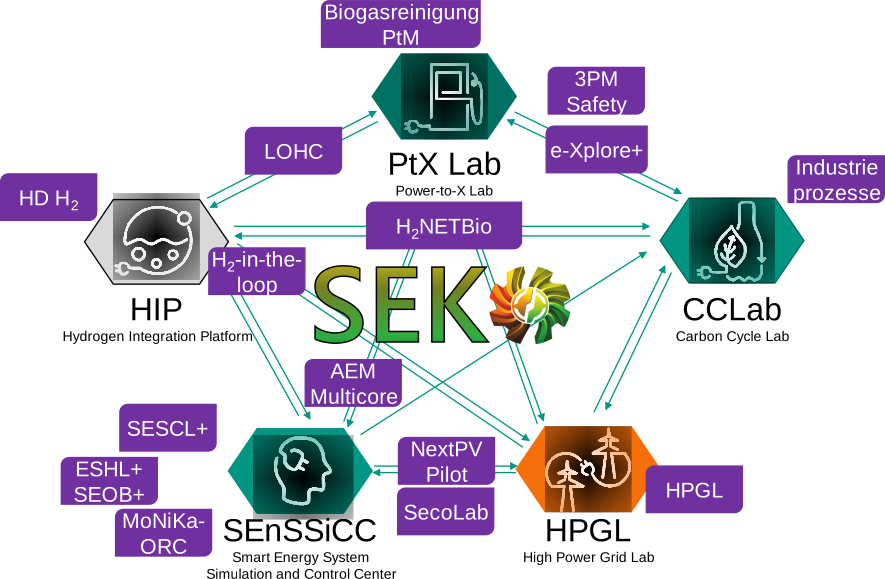
In the wake of the energy transition and the ambitious goal of decarbonizing the economy, a holistic view and integration of energy sectors is becoming increasingly important. The steadily growing share of renewable energies (RE) requires an intelligent, flexible, and cross-sector energy system that can balance fluctuations in generation and consumption. To make this possible, sector coupling is key: the linking of electricity, heating/cooling, gas/hydrogen, energy storage, fuels, and chemical energy carriers. This integration is made possible largely by information and communication technologies (ICT) and requires innovative research platforms that combine real and simulated systems.
Since 2015, the Karlsruhe Institute of Technology (KIT) has been developing the Energy Lab and Living Lab Energy Campus research infrastructures – today, these are unique real-world laboratories that enable future energy systems to be researched, tested, and optimized under real conditions. These platforms serve as a living research environment in which experimental and simulation-based approaches are combined to develop and demonstrate intelligent systems based on renewable energies.
The project „Energiesystemintegration & Sektorkopplung am Beispiel der Forschungsinfrastrukturen Energy Lab 2.0 und Living Lab Energy Campus (SEKO)“ – translated “Energy System Integration & Sector Coupling Using the Example of the Energy Lab and Living Lab Energy Campus Research Infrastructures (SEKO)” – funded by the Federal Ministry of Research, Technology and Space (BMFTR), has undergone continuous development since its launch in 2015. It was originally divided into four sub-projects that examined the sectors of electricity, heating/cooling, material energy carriers, and their ICT-based interconnection. Over the course of the project, these sub-projects were successfully completed and expanded through several extensions – most recently with the completion of the funded scientific work and the transition to funding for the real-world laboratory in March 2023.
Milestones achieved and scientific progress:
- Subproject 1 (electricity & sector coupling): High-resolution simulation models for asymmetrically loaded low-voltage grids were developed and integrated into real-time simulations. Cross-sector optimization in the Energy Smart Home Lab (ESHL) enables the creation of schedules for battery storage, heat pumps, and combined heat and power plants to minimize grid exchange. In addition, emulators for DC-based technologies and powerful measurement technology for neighborhood supply and electromobility were implemented.
- Subproject 2 (Heating/Cooling & Building Integration): A modular overall model of the thermal behavior of the Living Lab buildings was created and calibrated with real measurement data. The integration of weather data and CO₂ sensors enables precise consumption forecasts. In addition, new research approaches for CO₂ capture from indoor air (“Crowd Oil”) and for the direct conversion of hydrogen into electricity were established in research laboratories.
- Subproject 3 (Material Energy Sources & Power-to-X): Dynamic models for power-to-gas processes were developed and validated with measurement data from the pilot plant for methanization. A digital twin of the entire process chain was established. In addition, an optimized process for bioslurry gasification with green hydrogen was developed. New research approaches for CO₂ electrolysis and the synthesis of electricity-based fuels were initiated.
- Subproject 4 (ICT, cybersecurity & system integration): Data acquisition and visualization in the Energy Lab was expanded. A co-simulation framework (PROOF) was further developed to simulate complex systems more efficiently. In addition, security architectures for industrial automation and control systems (IACS) and semi-autonomous intrusion detection systems (IDS) for cybersecurity teams were researched.
Expansion and extension of the project:
Due to the dynamic development of the energy transition, new technological breakthroughs, and changed geopolitical conditions, the SEKO project was expanded in 2021, 2022, and 2023 to include additional research priorities and infrastructure investments. This expansion serves to create a comprehensive, future-proof research network that addresses current and future challenges of the energy transition.
Two main topics of the current expansion:
- Digital twins and co-simulations: Development of high-precision, cross-sector digital twins to map complex energy systems. These include real-time measurement and simulation platforms, thermographic test benches, and characterization tools for multimodal digital models – tested on the KIT North Campus (particle accelerator) as an example.
- Hydrogen & synthetic fuels: Expansion of research to include new technologies such as CO₂ electrolysis, power-to-methanol, bidirectional AC/DC converters, and fuel cell grid integration. In addition, three-phase methanation in the Energy Lab will be expanded to include an additional gas cycle and measurement technology in order to investigate hydrodynamics and reaction kinetics under real conditions.
New subprojects:
As part of the expansion, seven new subprojects have been established to align the research network with current technologies and political requirements, including V2G charging stations, packet-based power grids, autonomous cybersecurity solutions, high-performance databases, hydrogen storage systems, and research laboratories for CO₂-based fuels.
The SEKO project has evolved from an initial research project into a vibrant, evolving research network that advances sector coupling and system integration at the highest scientific and technical level. With the final phase running until June 2026 and ongoing expansions, the project is making a significant contribution to answering the question of how the energy transition and decarbonization of the economy can be achieved. The Energy Lab and Living Lab Energy Campus research infrastructures serve as models for future energy systems, both nationally and internationally, and represent a globally unique platform for interdisciplinary, practical energy research.